
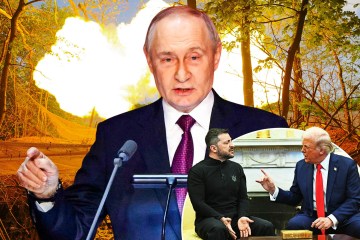

DONALD Trump’s crunch talks with Vladimir Putin are at risk of collapsing after a meeting between their aides was mysteriously cancelled.
US secretary of state Marco Rubio was due to meet with Russian Foreign Minister Sergey Lavrov to hammer out details of a peace deal but that has now been axed.
The pair spoke on Monday over the phone as a brief US State Department readout said the pair discussed the “next steps” in the conflict.
The Kremlin described the call as a “constructive discussion” that dealt with “possible concrete steps to implement the understandings” between Trump and Putin.
Both leaders agreed to meet in Hungary in the coming weeks after a “very productive” phone call last week.
Ukraine’s Volodymyr Zelensky has also declared he would be open to joining the talks to finally get a deal made.
DON’S PLAN FOR PEACE
Russia ‘snubs’ Trump’s plan to freeze Ukraine frontline

VLAD’S NAZI AMMO
Putin’s troops resort to using NAZI weapons in war after raiding museums
Only hours after Rubio and Lavrov spoke however plans appeared to drastically change.
A White House official confirmed to CNN that the two top diplomats wouldn’t be meeting in person anytime soon.
An official explanation for why Lavrov and Rubio didn’t hold the first of several key US-Russia meetings is yet to be revealed.
But due to their recent interactions, many have potentially suggested a key breakdown in communications.
One source familiar to the matter believes Rubio and Lavrov had widely differing expectations about how to end Russia’s invasion in this chat.
Rubio is now unlikely to recommend his president even attends a meeting with Putin, the source added.
Top US officials reportedly feel the Russian stance has not evolved enough for any constructive chats to take place between Trump and Putin.
This likely means that Moscow is continuing to refuse to end their invasion unless they are gifted as much Ukrainian territory as possible.
Trump had suggested the fairest way to divide up the key battlegrounds would be to simply pause the war based on the current frontlines.
Ukraine are said to be open to discussions around a possible freezing of warzones if they can be given security guarantees in return.
But an ever greedy Kremlin is refusing to accept any such trade-off.
Instead, Russia wants Ukraine to cede territory in Donetsk region allowing Putin to control more land than he has stolen.
Moscow also want Kyiv to demilitarise in a way which leaves them vulnerable to any future strikes.
The Kremlin has responded to the reports through Lavrov’s deputy foreign minister lackey Sergey Ryabkov.
He snapped back saying: “You cannot postpone what was not agreed upon.”
Putin’s spokesman Dmitry Peskov has also come out in the past 24 hours saying: “This answer is well known – the consistency of Russia‘s position doesn’t change.”
Despite the disagreements, Rubio and Lavrov could speak again this week to try and iron out their differences.
Trump’s divisive peace plan
As Trump battles to end another key global conflict, he is facing perhaps his toughest task to date – Kremlin’s fierce tyrant.
The pair met for historic peace talks in Alaska on August 15, where the plan in Trump’s eyes was to get Vlad to the negotiating table.
Things didn’t go quite to plan as the pair shared a jovial few hours in each other’s company.
Little geo-political work was undertaken regarding ending the war as Putin left to go back to Moscow and launch more deadly attacks on Ukraine.
His attacks have only ramped up in the two months since he met Trump with the Don only able to fire back through scathing Truth Social posts.
All eyes are now back on Ukraine following Trump’s Gaza peace declaration.
He hosted Volodymyr Zelensky in Washington last week as Kyiv pleaded with the US to send them Tomahawk missile to be used against Russia.
Pariah Putin faces humiliating 2,000 mile detour to get to crunch Trump talks
By Harvey Geh, Foreign News Reporter
VLADIMIR Putin faces a gruelling 2,000 mile detour ducking wartorn Ukraine and its staunchest allies to reach Donald Trump for crunch talks in Hungary.
The Russian pariah’s long and winding road to Budapest will see him dodge Nato and EU airspace as he ventures behind enemy lines to meet the US president.
With no clear way through the highly monitored Baltic states or a fiery Poland, the dictator is set to take what he hopes will be a scenic route to reach Hungary.
The backdoor path is believed to have roughly doubled the distance, with the flight now stretching to an estimated 2,000 miles which could take up to five hours.
And if he wishes to land safely in the Budapest without facing the International Criminal Court, Putin will need to also avoid the looming arrest warrant on his head.
And the US is also expected to play a key role in getting Putin face-to-face with Trump for the high-stakes talks, John Foreman CBE said.
The former UK Defence Attaché to Moscow told The Sun: “I think we can draw various routes on a map – but the key point is that the US will put enormous pressure on smaller, Orthodox, Nato countries in the Balkans to allow Putin through under diplomatic flight clearance.”
The most likely route Putin will take will be a marathon stretch from Russia to Turkey, then to Greece, over North Macedonia and Serbia, and then finally to Hungary, Foreman suggested.
Going over Montenegro and then into Serbia from the Adriatic Sea would be a very similar alternative path.
And international security expert Anthony Glees agreed that Putin would have to take a drawn out route to reach Trump.
He outlined a similar flight to the war-ridden Black Sea before circling round a ring of countries reaching Hungary.
Trump declined to agree to the deal and even erupted by shouting and swearing at Zelensky as he told him to accept Putin’s terms, sources told the Financial Times.
A defiant Zelensky managed to get the US leader back on side as Trump put forward a new peace plan.
On Sunday he suggested freezing the frontline and drawing new borders along it – which would mean Ukraine handing vast swathes to Russia.
This would give Putin almost full control of the Donbas – which he has demanded as a condition for ending the war – but for a small stronghold still under Ukrainian control in the Donetsk oblast.

mae day
Molly-Mae’s new show seriously concerns me… making Bambi centre stage will backfire

SCHOOL’S OUT
London’s best free indoor attractions for families – perfect for rainy days
Russia has so far failed to capture Ukraine’s sturdy “fortress belt” – but is adamant that any peace settlement will see it handed over.
But even this deal wasn’t good enough for the Kremlin.